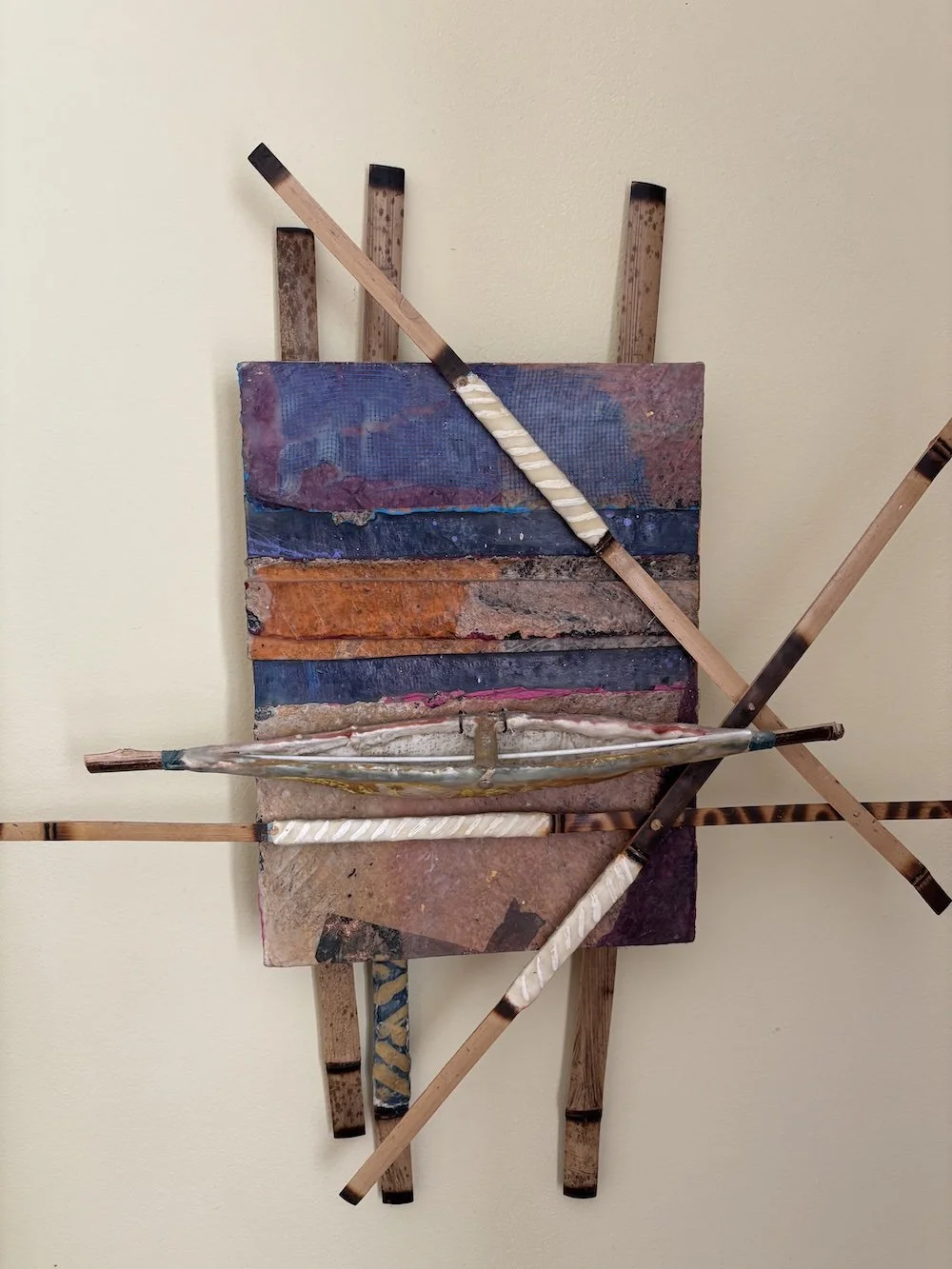
Money and art do not mix well. I once offered loans of M’s paintings to my colleagues at work, who eagerly chose pieces for their offices, and in some cases their homes. After a year or so, I asked for them back, unless they wished to purchase them. No one wanted to return the paintings, but neither did anyone want to pay for them. It took a surprising amount of effort to get them back.
On the other hand, I have made deals to pay some musicians in art credits, and this has worked out quite well. The deal is this: I pay either $125 per service in cash, or $250 in art credits. If they choose art credits, these mount up pretty fast. One concert plus three rehearsals is already $1000 in art credits. Five concerts could be more than $6000. The musician picks the art, and I pay the artist what I would have paid the musician in cash, i.e., half the value of the art credits. This is a good deal for all of us (if the musician loves the art). An art gallery would take 50%, so the artist is not really taking a loss. I view this as a kind of alternate economy. Now, one musician has taken this a step further, and has made the art available to her friends and relations. They are encouraged to select pieces, which they can receive as Christmas presents, as she accumulates credits. At least 20 paintings have been placed in this way.
What is a painting worth? To the IRS it is very simple: for deduction purposes, it is worth the value of the canvas and the paint applied (no hourly labor costs allowed), i.e., about $25. For taxation purposes, it is worth whatever the last purchaser of a similar item paid for it. If a painting sold for $4000 and you have an unsold inventory of 300 in your storage unit, they will assess your estate at $1.2 million. Not fair? Duh!
An art lover who covets a piece asks, how much is it? Well, the frame was $150, and the artist can’t bear to get less than $250 for herself, so the minimum price would be $400. Ouch, the collector says, $400 is too much for my budget! She offers $300, and the artist says OK, because the collector clearly loves the piece, and it will have a good home.
We purchase art, which is a very good discipline, if you expect other people to do it. We have purchased several pieces for $900-$1500, and have had no regrets. We have purchased many pieces for between $60 and $500, that are displayed all over our house. The only regrets are for the pieces we did not buy from artists who later passed away and their work disappeared, or from artists who became so famous that their work is now unaffordable.
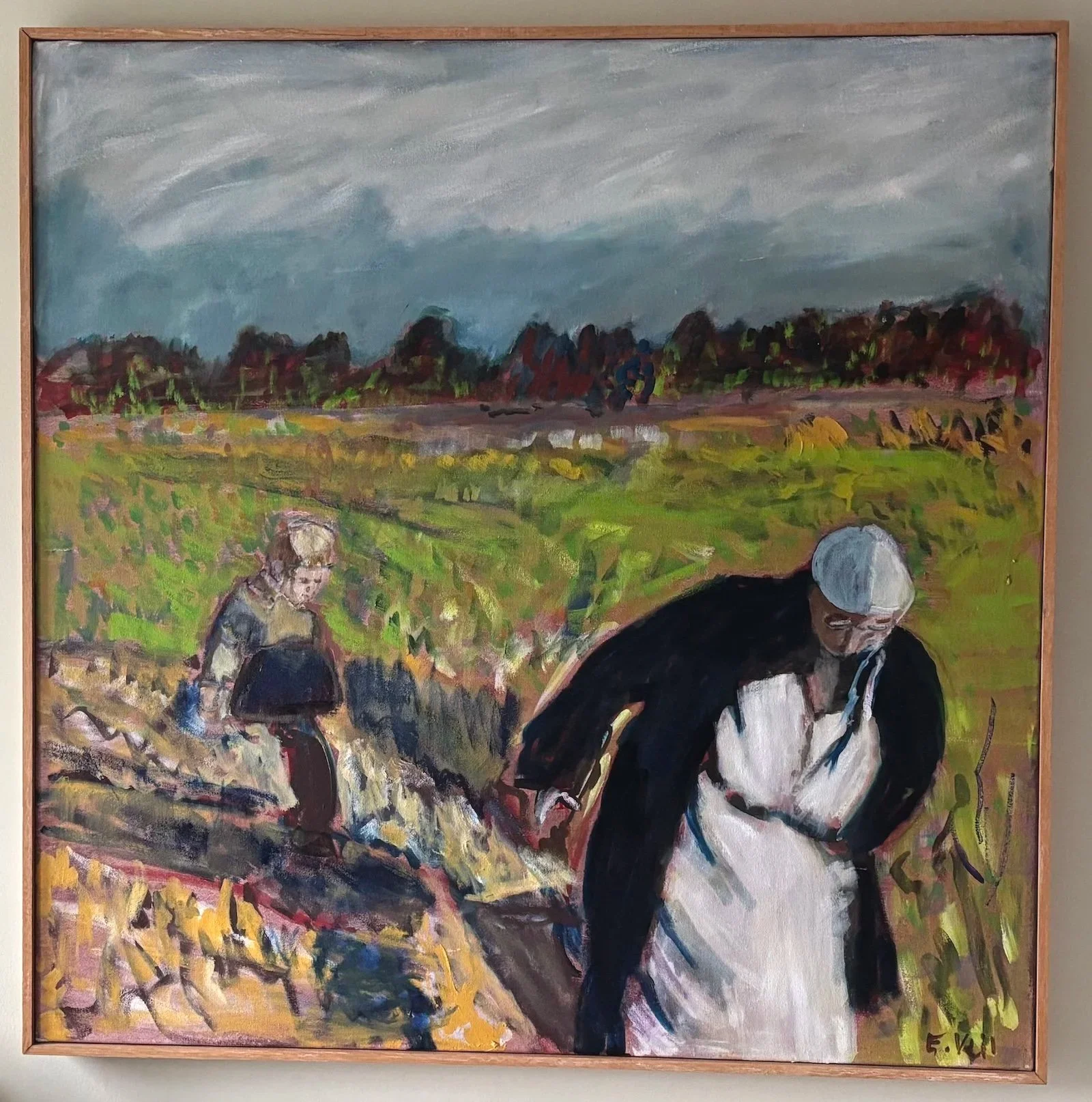
Liz Vail, oil on canvas, 36”x36”; the artists mother and daughter on the farm. collection of Marilyn & Carl Banner
Some of the artists whose works we have purchased (along with a few gifts and trades): Schroeder Cherry, Lisa Rosenstein, Bob Henry, Alonzo Davis, Michael David, Lori Anne Boocks, Alice Sims, Mei Mei Chang, Travis Childers, Julee Dickerson-Thompson, Mary McCoy, Howard McCoy, Paul Volker, Margaret Paris, Roberta Staat, Ellen Hart, Francy Caprino, Carol Hamoy, Marvin Bileck, Liz Vail, Donna Coleman, Celeste Wiser, Barbara Bickley, Ruth Bauer-Neustadter, Debra Claffey, Michael Billie, Elizabeth Vismans, Jill Lion, Dominie Nash, Lisa Pressman, Catherine Cummings, Sandy Lupton, Alvin Thomas, Amdy Adje, Matt Sesow, Dana Ellyn, Carol MacDonald, Tania Kravath, Megan Hinton, Joyce Weinstein, Pat Blakemore, Charlie Buehler, Jane Rosser, and a young Salvadoran-American artist whose signature is illegible.